
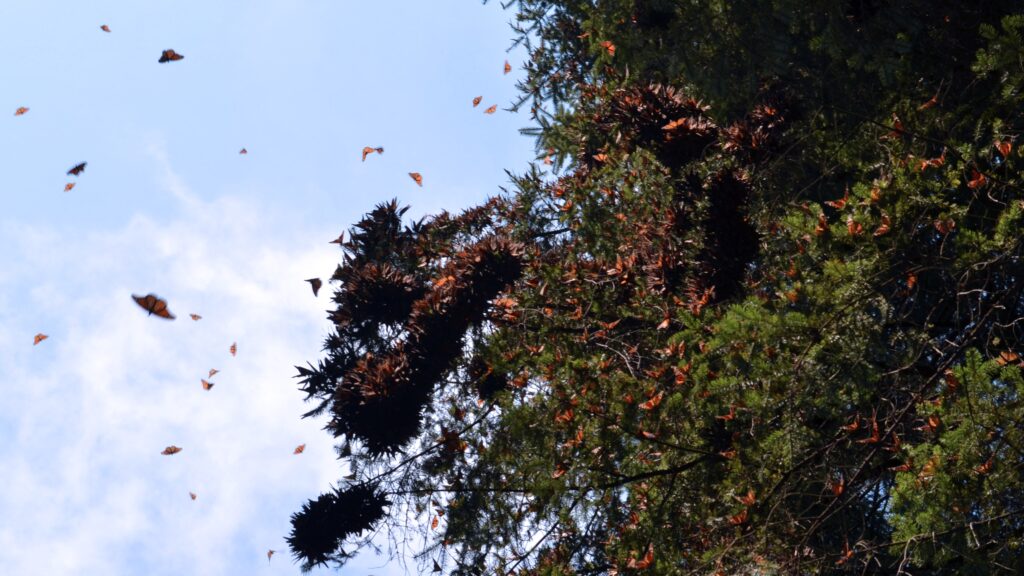
New survey results released this week by Mexico’s National Commission of Protected Natural Areas (CONANP) and the World Wildlife Fund (WWF) for the 2025–2026 overwintering season of the eastern monarch butterfly population show encouraging progress. According to the newly released report, monarch colonies occupied 7.24 acres of forest, up from 4.42 acres during the 2024–2025 winter. That represents a 64% increase year over year, a significant rebound after several difficult seasons.
Scientists measure the size of the eastern monarch population by calculating how much forest the butterflies occupy at their overwintering sites in central Mexico. Instead of counting individual butterflies, researchers measure the number of acres covered by monarch colonies. That measurement is considered the most reliable way to track long-term population trends.
This method is different from how the western monarch population is monitored. In the western United States, monarchs overwinter in smaller, more scattered sites along the California coast, where volunteers and researchers are able to count individual butterflies. The eastern migration is far larger, which is why scientists rely on the total area of forest occupied.
Researchers documented nine eastern monarch colonies in total this winter, three in Michoacán and six in the State of Mexico. Five of those colonies were located inside the Monarch Butterfly Biosphere Reserve, while four were located outside of it.
The largest colony was recorded in Ejido El Rosario in Michoacán, occupying just over four acres on its own.
Encouraging progress but still far below historic levels
While the increase is encouraging, the overall population remains well below where it once was. The report notes that monarch colonies covered nearly 45 acres of forest at their peak in the late 1990s. In contrast, the population has experienced major fluctuations in recent years, including one of the lowest totals ever recorded just a few winters ago.
This year’s increase shows that the migration can still rebound when conditions improve, but it also highlights how fragile the population remains. The butterflies that fill the forests in Mexico each winter are the same monarchs that spend the spring and summer across the United States and Canada, including on farms, ranches, and other working lands.
The report highlights several ongoing threats to the eastern monarch population, including the loss of milkweed in breeding areas, land-use changes across North America, and the growing impacts of climate change. That means the future of the migration depends on habitat across the entire continent, not just in Mexico.
Farmers for Monarchs works directly with farmers, ranchers, and landowners who want to establish monarch habitat or expand the habitat they already have in place. Whether you are just getting started or looking to build on existing conservation practices, Farmers for Monarchs can help connect you with technical guidance, practical resources, and information about conservation programs that may help support habitat establishment on working lands.
This year’s increase is encouraging, but long-term recovery will depend on continued habitat across the monarch flyway. Farmers and landowners play a critical role in that effort and Farmers for Monarchs is here to help.